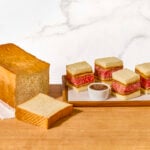
Wagyu Katso Sando Recipe
Learn how to make a panko-crusted Wagyu katsu sando from scratch. I'll walk you through every foolproof step, from baking soft shokupan to frying perfectly cooked Japanese Wagyu for the perfect sandwich.
Servings: 4 servings
Equipment
- 1 Stand Mixer Fitted with a Dough Hook
- 2 Saucepans
- 1 (9x5-inch) Shokupan
- 1 Pastry Brush
- 1 Wire Cooling Rack
- 1 High-Speed Blender
- 1 Fine Mesh Sieve
- 3 Shallow Bowls
- 1 Heavy-Bottomed Pot or Dutch Oven
- 1 Instant-Read Thermometer
- 1 Sharp Chef's Knife
- 1 Cutting Board
Ingredients
For the Shokupan
Tangzhong
- 2 tablespoon bread flour
- 3 tablespoon water
- 3 tablespoon whole milk
Dough
- 1 tablespoon active dry yeast
- 2½ cup bread flour
- ¼ cup nonfat dry milk powder
- ¼ cup granulated sugar
- 1 teaspoon kosher salt
- ½ cup whole milk
- 1 large egg
- 4 tablespoon unsalted butter melted
- 1 tablespoon unsalted butter softened, for greasing the pan
For the Tonkatsu Sauce
- 1 medium apple (~180 gram) peeled and grated
- ½ medium onion (~75 gram) grated
- 2 garlic clove (~6 gram) grated
- 1-inch (2½ centimeter) piece fresh ginger (~15 gram) grated
- ½ cup soy sauce
- ¼ cup mirin
- ¼ cup rice vinegar
- 3 tablespoon brown sugar
- 2 tablespoon ketchup
- 2 tablespoon Dijon mustard
- 1 tablespoon Worcestershire sauce
For the Wagyu Katsu Sando
- 4 Japanese Wagyu striploin or ribeye fillet (4 ounce / 120 gram each)
- 2 tablespoon all-purpose flour
- 1 large egg
- 3 tablespoon water
- 1 cup Japanese panko breadcrumbs
Instructions
Make the tangzhong
- In a small saucepan, whisk together the bread flour, water, and milk until completely smooth with no lumps remaining. Cook over low heat, whisking constantly, until the mixture thickens and the whisk leaves visible lines on the bottom of the pan, about three to five minutes. Transfer to a small bowl and let cool until just lukewarm.3 tablespoon water, 2 tablespoon bread flour, 3 tablespoon whole milk
Make the dough
- Stir the active dry yeast into the warm tangzhong and let it sit until it begins to bubble and pop, about five minutes.1 tablespoon active dry yeast
- In the bowl of a stand mixer fitted with a dough hook, combine the tangzhong with the remaining dough ingredients. Mix on medium speed until a smooth, elastic dough forms, 12 to 15 minutes. The dough should feel smooth and slightly tacky.2½ cup bread flour, ¼ cup nonfat dry milk powder, ¼ cup granulated sugar, 1 teaspoon kosher salt, ½ cup whole milk, 1 large egg, 4 tablespoon unsalted butter
- Shape the dough into a ball and place it in a large bowl lightly greased with butter. Cover and let it rise in a warm place until puffy, about one to one and one-half hours. The dough will puff but not fully double in size.1 tablespoon unsalted butter
- Gently deflate the dough and divide it into three equal pieces (about 230 grams each). Working with one piece at a time, flatten it into a five by seven-inch (12.7 x 17.8 cm) rectangle. Fold the short ends inward like a letter, then flatten again into a four by six-inch (10.2 x 15.2 centimeter) rectangle. Starting from a short end, roll it into a tight log.
- Arrange the logs seam-side down in a lightly greased nine by five-inch (22.9 x 12.7 centimeter) shokupan, placing them side by side.
- Cover and let rise until noticeably puffy, 40 to 50 minutes. Toward the end of proofing, preheat the oven to 350°F (176°C).
- Brush the top of the loaf with milk. For a perfectly square loaf, place the lid on the pan before baking.
- Bake for 25 to 30 minutes, or until deeply golden brown and an instant-read thermometer inserted into the center registers at least 190°F (88°C).
- Let the loaf cool in the pan for ten minutes, then transfer it to a wire rack and cool completely before slicing.
For the Tonkatsu Sauce
- Combine all the sauce ingredients in a small saucepan and bring to a simmer over low heat.1 medium apple (~180 gram), ½ medium onion (~75 gram), 2 garlic clove (~6 gram), 1-inch (2½ centimeter) piece fresh ginger (~15 gram), ½ cup soy sauce, ¼ cup mirin, ¼ cup rice vinegar, 3 tablespoon brown sugar, 2 tablespoon ketchup, 2 tablespoon Dijon mustard, 1 tablespoon Worcestershire sauce
- Cook, stirring occasionally, until slightly reduced and fragrant, about 45 minutes.
- Transfer the mixture to a high-speed blender and purée until smooth.
- Strain the sauce through a fine-mesh sieve into a clean bowl for a silky texture.
- Let cool. The sauce will thicken into a glossy, spoonable consistency as it sits.
For the Katsu Sando
- Trim the Wagyu striploin or ribeye into clean squares about one and one-half to two inches (three to five centimeters) thick, weighing about four ounces (120 grams) each. Season with salt and pepper just before breading.4 Japanese Wagyu striploin or ribeye fillet (4 ounce / 120 gram each)
- Place the flour in one shallow bowl. In a second bowl, whisk together the egg and water until smooth. Place the panko in a third bowl. Lightly coat each piece of Wagyu in flour, dip it into the egg mixture, then coat with panko, gently pressing the breadcrumbs to adhere without compacting them. The coating should feel light and airy.2 tablespoon all-purpose flour, 1 large egg, 3 tablespoon water, 1 cup Japanese panko breadcrumbs
- Heat a neutral oil to 315-325°F (157-163°C). Fry the Wagyu, turning frequently, until the crust is pale golden and the internal temperature reaches 125°F (52°C), about three to four minutes total.
- Transfer the Wagyu to a wire rack and let it rest for five minutes. The internal temperature will rise to about 130°F (54°C) as the juices redistribute.
- Cut the shokupan into one-inch (two and a half centimeter) slices. Day-old bread works best for structure. Lightly butter one side of each slice and toast, buttered-side down, in a pan over medium-low heat until just golden, leaving the outer sides soft.
- Place one slice of bread toasted-side up. Spread a thin layer of tonkatsu sauce over the toasted side. Top with a Wagyu cutlet and another slice of bread, toasted-side down, pressing gently to adhere.
- Using a sharp knife, trim away the crusts so they align with the cutlet and form a clean square.
- Using a sharp, clean knife and wiping the blade between each cut, slice the sandwich into four equal squares.
- Serve immediately.
Video
Notes
*Adjust the ingredient amounts in the recipe instructions accordingly if doubling or tripling the recipe.
Storage:
- Refrigerator: This Wagyu katsu sando is best enjoyed immediately while the crust is crisp and the bread is soft. If you have leftovers, store the sandwich in an airtight container in the refrigerator for up to one day. Keep in mind that the bread and panko coating will soften as they sit.
- Reheating: For the best texture, reheat the Wagyu cutlet in a 350°F (176°C) oven or air fryer until warmed through and the coating is crisp again. Avoid the microwave, which can make the panko soggy. Toast fresh slices of shokupan and assemble the sandwich just before serving.
- Freezing: I don't recommend freezing the fully assembled sandwich. However, you can freeze the baked shokupan loaf (whole or sliced) for up to three months. Wrap it tightly in plastic wrap and foil, then thaw at room temperature before using.
- Refrigerator: This Wagyu katsu sando is best enjoyed immediately while the crust is crisp and the bread is soft. If you have leftovers, store the sandwich in an airtight container in the refrigerator for up to one day. Keep in mind that the bread and panko coating will soften as they sit.
- Reheating: For the best texture, reheat the Wagyu cutlet in a 350°F (176°C) oven or air fryer until warmed through and the coating is crisp again. Avoid the microwave, which can make the panko soggy. Toast fresh slices of shokupan and assemble the sandwich just before serving.
- Freezing: I don't recommend freezing the fully assembled sandwich. However, you can freeze the baked shokupan loaf (whole or sliced) for up to three months. Wrap it tightly in plastic wrap and foil, then thaw at room temperature before using.
Nutrition
Serving: 1serving | Calories: 1003kcal | Carbohydrates: 119g | Protein: 47g | Fat: 37g | Saturated Fat: 18g | Polyunsaturated Fat: 3g | Monounsaturated Fat: 13g | Trans Fat: 1g | Cholesterol: 228mg | Sodium: 2652mg | Potassium: 892mg | Fiber: 5g | Sugar: 39g | Vitamin A: 869IU | Vitamin C: 4mg | Calcium: 256mg | Iron: 5mg